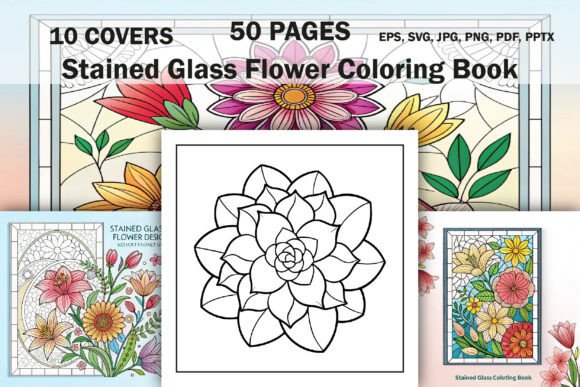
Stained Glass Farm Animals Coloring Book
A Designer’s First Glance: Charm with Clear Boundaries
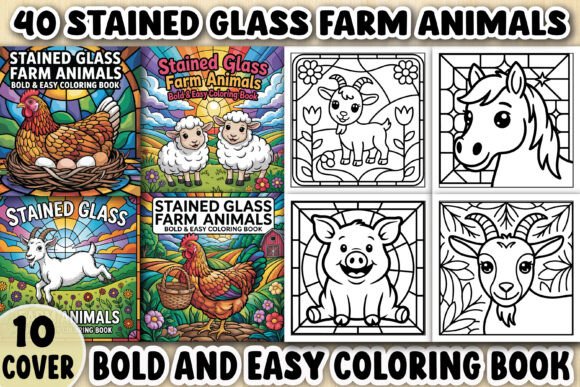
Opening Stained Glass Farm Animals Coloring Book, I felt that familiar quiet lift—the kind you get when a design invites calm before complexity. The bold outlines, generous negative space, and intentional simplification of farm animals (think roosters, sheep, pigs, and calves) aren’t just “easy”—they’re embroiderably generous. As someone who’s stitched hundreds of client projects—from boutique aprons to baby onesies—I immediately saw how these pages translate into clean, confident embroidery. This isn’t delicate linework or fussy detail; it’s shape-first storytelling. That matters. A lot.
Where It Shines: Real Projects, Real Fabric
I tested the core animal motifs as a machine embroidery design on a natural linen tea towel—no applique, no background fill—just satin-stitched outlines and subtle fill stitch within each pane-like section. The result? Crisp, legible, and quietly joyful. That same rooster motif worked beautifully as a centered sweatshirt embroidery on midweight cotton fleece—no puckering, no lost definition. And yes, it held up on a curved cap front when resized to 3.2" wide and paired with lightweight cutaway stabilizer.
For small business owners and Etsy sellers, this is gold: the Stained Glass Farm Animals Coloring Book lends itself naturally to personalized gifts (a custom embroidered pillow cover for a new farmer’s market vendor), nursery decor (framed hoop art with gentle pastel thread), and holiday merchandise (a set of embroidered kitchen towels sold as a “Farmhouse Christmas” bundle). Its visual personality—warm, unhurried, gently nostalgic—builds instant brand consistency for craft businesses leaning into rustic, handmade, or slow-living aesthetics.
Where to Pause: Texture, Scale, and Fabric Reality
That said, not every surface welcomes stained glass style equally. On highly textured fabrics like bouclé or thick terry cloth, fine interior lines can blur. On stretchy knits—especially lightweight tees—the bold outlines hold, but tight corners (like the tip of a pig’s snout or a chicken’s comb) may distort if hooping isn’t precise or stabilizer isn’t layered thoughtfully. Dark fabric demands careful thread color contrast: a light yellow fill stitch reads beautifully on cream linen but disappears on charcoal unless you boost density or switch to metallic or high-sheen rayon.
Small hoop sizes (under 4") require selective editing—trimming outer decorative borders or simplifying inner panes. And while the design avoids tiny lettering or micro-details (a huge plus), don’t assume it’s auto-pilot ready for curved surfaces like baseball caps or baby booties without testing stitch placement and pull compensation. Also, avoid dense fill areas in high-wash items (like kids’ bibs or dish towels) unless you’ve confirmed thread durability and stabilizer washout behavior.
Design Assets That Earn Their Place
As a digital embroidery file source, Stained Glass Farm Animals Coloring Book stands out because its Graphics origin shows in its clarity—not as clipart, but as intentional shape language. That makes it unusually adaptable: convert one page into an embroidered patch with clean satin-stitched edges, or isolate a single calf silhouette for a minimalist tote bag design. It works for both personal stitching and commercial embroidery—if your license permits resale of finished products (check that before listing on Etsy or at craft fairs).
What elevates it beyond novelty is how it supports customer trust. When buyers see this on a handmade product, they recognize craftsmanship—not just decoration. The stained glass framing suggests care, intention, even reverence for the subject. That translates directly to perceived value: a $28 embroidered tea towel feels worth it because the design says “made with attention,” not “printed fast.”
Practical Notes from the Hoop
Before cutting fabric or loading your machine:
- Always test first—on scrap fabric matching your final substrate, with your exact stabilizer and thread colors.
- Review stitch density—some interior panes may run lighter than others; adjust if needed for fabric weight or wear expectations.
- Confirm hoop size compatibility—the full-page layouts are expansive, but individual animals scale cleanly down to 2.5" without losing character.
- Inspect small details—especially where limbs meet bodies or where panes intersect. What reads as crisp line art on paper must translate to secure satin stitch in thread.
- Mock it in black and white—this design relies on contrast, not color. If it lacks punch in grayscale, it’ll lack presence in stitch.
- Compare light vs. dark backgrounds—not just for visibility, but for how thread sheen interacts with fabric texture.
- Use proper stabilizer—cutaway for knits, tear-away for stable wovens, and always match weight to your fabric and stitch count.
- Verify licensing—since this lives in the Coloring Pages Amp category, confirm whether the Graphics files include commercial use rights for finished embroidered goods or digital embroidery files.
Final Thought: Not Just Cute—Consistently Capable
The Stained Glass Farm Animals Coloring Book doesn’t shout. It settles in—like a well-worn apron, a favorite mug, or a hand-stitched name tag on a child’s backpack. That’s its strength. For embroidery designers and creative entrepreneurs, it’s not about trend-chasing. It’s about having a reliable, mood-aligned design asset that performs across categories: from a single-embroidered patch on a denim jacket to a coordinated set of holiday kitchen linens. It respects the maker’s time, the machine’s limits, and the buyer’s eye. In a market flooded with overly complex or forgettably generic graphics, that kind of quiet capability is rare—and worth stitching carefully.