Stained Glass Flower Coloring Book for a Graphics & Coloring Pages Amp
First Impression: Delicate, Light-Filled, and Quietly Sophisticated
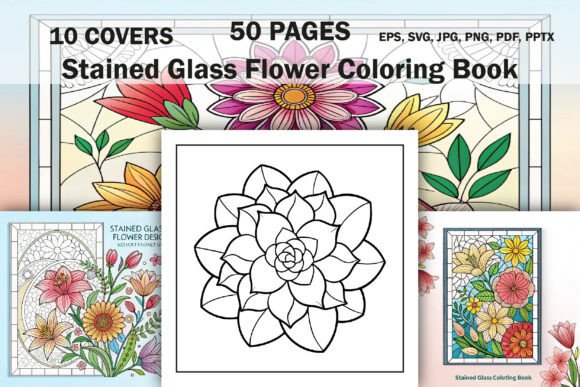
Opening Stained Glass Flower Coloring Book for a, I immediately sensed its quiet confidence—not loud or trendy, but deeply intentional. The linework is precise yet organic, with floral forms built from interlocking geometric fragments that echo cathedral windows without leaning into literal religious iconography. It’s not “cute” or “kawaii”; it’s elegant, meditative, and quietly luxurious. For a client project rooted in handmade business, botanical wellness, or slow-living branding—think an artisanal tea line, a seasonal flower subscription, or a mindfulness retreat—the mood it sets is instantly cohesive. It doesn’t shout; it invites pause. That makes it unusually effective as a graphic design asset where emotional resonance matters more than visual noise.
Where It Shines in Real Client Work
In packaging design, Stained Glass Flower Coloring Book for a works beautifully as a foil to minimalist typography—imagine it wrapping a small apothecary jar of lavender salts or printed as a subtle foil-stamped motif on kraft gift tags. As social media graphics, its high-contrast outlines translate cleanly to Instagram posts and Pinterest pins, especially when layered over soft gradients or muted linen textures. For print-on-demand sellers, it scales well across mugs, tote bags, and wall art—its symmetrical balance ensures no awkward cropping on circular or rectangular substrates.
It excels in editorial design and blog visuals: pair one full-page floral window motif with a serif font for a wellness newsletter header, or use simplified sections as decorative dividers in a Canva template for coaches. As a Cricut project, the clean SVG-ready lines cut precisely—even on delicate cardstock—and hold up beautifully in sublimation design for ceramic tiles or cotton apparel. And for Etsy product mockups? It adds instant visual credibility—no stock-photo flatness, just authentic, hand-crafted warmth.
Strategic Placement: Hero Graphics, Not Supporting Cast
This isn’t filler clipart. Stained Glass Flower Coloring Book for a performs best when given breathing room: large layout areas (e.g., website hero banners), product mockups (especially transparent or glass-adjacent items), and themed collections (e.g., “Spring Serenity” printable design bundles). Its strength lies in decorative accents—border elements for wedding invitations, corner flourishes on boutique product labels, or background repeats for digital ads targeting mindful audiences. In brand identity systems, it functions powerfully as a secondary illustration system—complementing a clean sans serif logo without competing.
Where Caution Is Essential
Don’t force it into cramped spaces. At under 0.5 inches wide, fine lead lines blur or vanish—avoid using it in small-scale sticker design or tiny app icons. It also struggles in low-contrast environments: place it on busy photographic backgrounds or near similarly intricate patterns, and visual hierarchy collapses. Skip it for professional corporate materials (law firms, fintech dashboards) or minimalist branding that prioritizes stark clarity over ornamental depth. And while it’s emotionally rich, it lacks the neutrality required for universal wayfinding or data visualization—it’s a creative design asset, not a functional UI element.
Design Judgment: Readability, Trust, and Audience Alignment
Readability stays strong when paired with high-contrast type—test it beside both serif (e.g., Playfair Display) and modern sans serifs (e.g., Inter). Its inherent symmetry and rhythm reinforce brand consistency across touchpoints, especially for small business branding anchored in authenticity and craft. Visually, it builds trust: consumers associate stained glass motifs with care, tradition, and intentionality—ideal for handmade business positioning. But be mindful—overuse dilutes impact. One well-placed motif in a campaign delivers more emotional appeal than five scattered across a landing page.
Practical Designer Notes Before Client Deployment
- Always test in black and white—many coloring pages rely on contrast, not color, so verify line weight holds up in monochrome print.
- Check contrast on light AND dark backgrounds; some versions include light-line variants that fade on white—confirm which PNG or SVG files ship with solid fills.
- Preview at actual size: zoom out to 25% to simulate mobile viewing; zoom in to 200% to inspect anchor points if editing vectors.
- Place on real mockups: drop it into a t-shirt or mug template—not just a flat PSD—to assess proportion and focal weight.
- Test print quality: run a sample on your target paper stock (e.g., matte 120gsm vs. glossy photo paper) to confirm line crispness.
- Review file formats: confirm whether you’re getting editable SVGs (for scaling), transparent PNGs (for web overlays), or raster-only JPGs (limiting flexibility).
- Inspect transparency: if PNGs are included, ensure anti-aliased edges don’t leave faint halos on dark backgrounds.
- Compare font pairings: it harmonizes with script fonts (for elegance) and display fonts (for contrast), but can overwhelm handwritten styles—test before finalizing a Canva template or invitation suite.
- Verify commercial license: confirm usage rights cover your client’s end use—especially for print-on-demand, sublimation design, or digital product resale.
Final Verdict: A Thoughtful, High-Value Creative Asset
Stained Glass Flower Coloring Book for a isn’t just another coloring page bundle—it’s a versatile, mood-driven graphic design asset with clear strategic utility. When aligned with the right client (a botanical skincare line, a yoga studio launch, a curated printable shop), it elevates the entire visual language—not through novelty, but through quiet cohesion. Used intentionally—as hero graphics, packaging details, or thematic anchors—it reinforces brand values like calm, craftsmanship, and mindful beauty. For designers sourcing reliable, licensable design assets for real-world projects, this stands out not for flash, but for function, feeling, and finish.