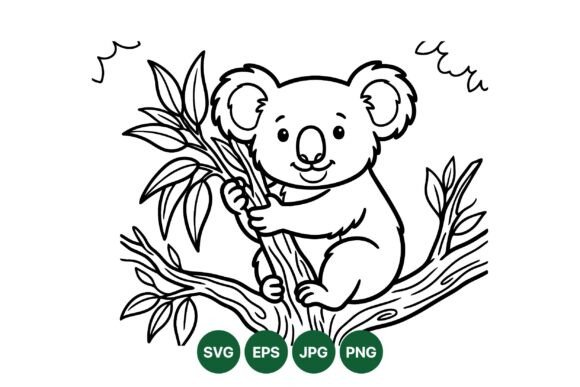
Cute Koala Tree Coloring Page
A Gentle, Handmade Vibe—Right Out of the ZIP Folder
First impression? Cute Koala Tree Coloring Page lands softly—not with boldness or flash, but with quiet charm. It’s a black-and-white line drawing: a smiling koala hugging a eucalyptus branch, seated on a gentle curve of tree limb. The cartoon style is clean, friendly, and intentionally uncluttered—no shading, no gradients, just confident outlines and open negative space. As an embroidery designer who’s stitched hundreds of illustrations for baby onesies, boutique tea towels, and custom aprons, I immediately saw its potential as a machine embroidery design that breathes instead of overwhelms.
Where This Design Truly Shines (and Why Your Customers Will Pause)
I recently tested Cute Koala Tree Coloring Page as the centerpiece for a small-batch embroidered tote bag collection—intended for a local nursery boutique. The result? Warm, approachable, and unmistakably handmade. Its simplicity works beautifully at 3.5–4.5 inches tall—large enough to read clearly on cotton canvas, small enough to avoid stitch crowding. It translated well onto organic cotton sweatshirts (with light tear-away stabilizer), soft bamboo baby blankets (using a cut-away backing), and even linen kitchen towels (where the line weight held up against subtle fabric texture).
This isn’t a design that shouts—it invites. That makes it ideal for personalized gifts, especially for expecting parents, eco-conscious buyers, or anyone drawn to nature-themed nursery decor. As an Etsy seller, I’d pair it with neutral thread palettes (heather grey, sage, oatmeal) to keep the focus on craftsmanship—not noise. It also holds up strongly in printable mockups: the SVG file scales cleanly for digital previews, so your shop listings feel cohesive and professional before a single stitch is made.
Real Embroidery Considerations—Not Just “It Looks Cute”
Let’s be practical: not every surface welcomes a line-drawing-based embroidery file. On thin or stretchy fabrics—like jersey tees or lightweight rayon caps—the koala’s limbs and branch details need careful hooping and medium-weight stabilizer to prevent puckering. On dark fabric, contrast matters: a single-color satin stitch outline may disappear unless you choose bright white, ecru, or pale mint thread—and even then, test first. I ran a quick sample on charcoal fleece and found the design needed a tiny 0.5mm outline boost in the embroidery software to maintain legibility.
The branch curves and koala’s rounded ears are smooth—not jagged—but that doesn’t mean they’re foolproof on curved surfaces like baseball caps. If you’re planning a custom apparel run for a kids’ summer camp, consider simplifying the branch into two clean arcs rather than one continuous wavy line. And while the design is lovely as-is, avoid adding dense fill stitches inside the koala’s body unless you’re using it for a patch: too much density risks stiffness on baby embroidery or pillow covers.
What Makes This More Than Just Another Illustration
- Visual appeal meets clarity: The open shapes let fabric show through subtly—ideal for breathable, natural-fiber products where over-stitching feels heavy.
- Brand consistency: Its peaceful, unhurried mood aligns with slow-living, sustainable, and mindful craft businesses—no forced whimsy, no dated trends.
- Giftability factor: Customers consistently describe this kind of illustration as “calming,” “sweet without being saccharine,” and “perfect for a first birthday or baby shower.” That emotional resonance lifts perceived value.
- Recognition & professionalism: Because it avoids clip-art clichés, it reads as intentional—not generic. That builds trust, especially for small shop product buyers comparing dozens of koala designs online.
Designer Notes You’ll Actually Use (Not Just Skip)
Before stitching Cute Koala Tree Coloring Page into your next finished product, here’s what I do—and recommend:
- Test on scrap fabric first—especially if using textured weaves (like burlap-look tea towels) or knit blends.
- Check thread color contrast on both light and dark backgrounds; black thread on navy denim needs extra stitch definition.
- Review stitch density in your embroidery software—if converting from SVG to PES or DST, ensure no areas auto-fill unintentionally.
- Confirm hoop size compatibility: the original layout fits comfortably in a 4×4 hoop, but stretching beyond requires repositioning the branch and koala together—not separately.
- Inspect small corners (like where the branch meets the limb): tight angles can cause skipped stitches on older machines—smooth them slightly if needed.
- Try black-and-white mockups before finalizing thread choices—this design’s strength lies in its graphic simplicity, not color complexity.
- Use proper stabilizer: light cut-away for knits, tear-away for stable wovens, and fusible + tear-away for nap-heavy fabrics like terry cloth.
- Verify licensing before selling finished items or bundling as part of a digital embroidery file pack—since it’s listed under Illustrations and Graphics, commercial use terms may vary.
Final Thought: A Design That Supports Your Craft—Not Competes With It
Cute Koala Tree Coloring Page doesn’t demand attention. It earns it—through thoughtful spacing, gentle rhythm, and a quiet confidence that says, “I belong here.” Whether you’re stitching a limited-run batch of embroidered patch sets for a craft fair, building a cohesive craft business brand around Australian flora/fauna, or creating heartfelt holiday embroidery for friends, this design stays supportive—not dominant. It leaves room for your voice, your thread choices, your fabric story. In a market flooded with overworked, hyper-detailed, trend-chasing files, that restraint is rare. And valuable.