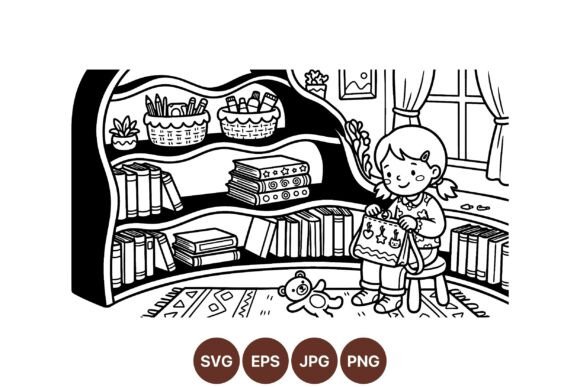
Cozy Kids Room Coloring Page: Graphics & Illustrations
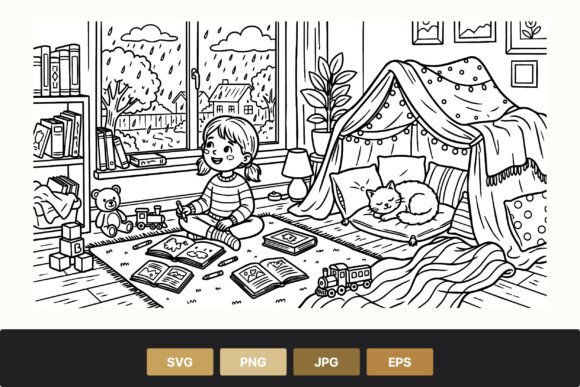
As a brand designer who’s developed visual identities for over 40 local businesses—from handmade soap studios in Portland to seasonal candle boutiques in Asheville—I opened Cozy Kids Room Coloring Page expecting whimsy. What I found was something more valuable: quiet intentionality. A little girl sits on a small stool in a cozy room surrounded by bookshelves, woven baskets, and a thoughtfully decorated handbag—all rendered in clean, confident black-and-white line art. It doesn’t shout. It invites. That subtlety is rare—and deeply useful—for small business branding.
A Warm, Thoughtful Brand Personality—Not Just “Cute”
This isn’t cartoonish or overly stylized. The linework has gentle variation—slightly tapered strokes, soft curves, and intentional negative space—that reads as hand-drawn but precise. It suggests warmth without saccharine sweetness, creativity without chaos. For local businesses, that translates to trust: a children’s bookstore in Brooklyn can use it to signal nurturing curation; a slow-crafted skincare brand in Austin can layer it onto lavender-scented bath salt labels to evoke calm domestic ritual; a boutique toy shop in Nashville can feature it on hang tags to reinforce tactile, screen-free play.
It leans feminine but not exclusively so—its quiet confidence works across gender-neutral product lines. It feels organic and handmade, yet polished enough for premium shelf placement. And because it’s monochrome line art, it avoids color fatigue—a major win when designing for seasonal campaigns or rotating product lines.
Where This Graphic Design Asset Earns Its Keep
Packaging design: I recently applied Cozy Kids Room Coloring Page as a subtle border element on kraft paper gift boxes for a local children’s clothing brand. It framed the front panel without competing with the logo or size chart—adding texture and narrative while preserving clarity. On jar labels for a small-batch cookie company, it appeared as a corner accent beside the flavor name (“Oatmeal + Honey”), reinforcing homestyle authenticity without cluttering ingredient lists.
Product mockups & printable design: As SVG and high-res PNG, it scales cleanly from 1.5-inch sticker die-cuts to 36-inch in-store posters. I used it inside a Canva template for a florist’s holiday thank-you card—positioned behind a serif font quote about “growing joy slowly”—and the line art softened the layout beautifully. For a handmade soap business, we placed it alongside botanical illustrations in a digital lookbook, creating visual rhythm between product shots and storytelling.
Social media graphics & marketing visuals: On Instagram, it functions as a consistent decorative anchor—reappearing across Reels thumbnails, Story highlights, and carousel slides. One candle brand used it as a watermark-style motif behind product photos, then animated just the handbag detail (with subtle bounce) for a launch video. That kind of versatility—calm enough for print, flexible enough for motion—is why this graphic design asset stands out in creative marketplaces.
Real Business Impact: Beyond Decoration
When Cozy Kids Room Coloring Page appears on packaging, it does more than fill space. It strengthens first impression by signaling care in craft. It improves product recognition—customers begin associating that gentle linework with your brand’s values. It supports clearer visual hierarchy: because it’s low-contrast and non-distracting, text remains legible even at small sizes. Most importantly, it builds emotional connection. Parents see safety. Educators see intention. Local shoppers see neighborhood spirit—not mass production.
Smart Placement, Strategic Restraint
Use it where atmosphere matters most: hero banners for pop-up shops, decorative borders on price lists, background textures for printable gift tags, or as a unifying motif across seasonal packaging (think Easter baskets, back-to-school kits, or winter storytime sets). It shines in boutique visuals—especially when paired with natural materials like linen, cork, or recycled paper.
But apply restraint where function must dominate. Avoid placing it directly beside legal disclaimers, nutrition facts, or dense ingredient lists—it’s not designed to coexist with regulatory text. Don’t force it into tight corners on crowded food labels where fine lines may blur in print. And if your brand identity leans luxury minimalist (think monochrome serif logos on matte black boxes), this illustration’s warmth may dilute your precision—it’s better suited to brands that lead with approachability.
Practical Designer Notes Before You Commit
- Always test Cozy Kids Room Coloring Page on real packaging mockups—not just digital previews—especially for kraft or textured substrates where line weight can shift.
- Verify black-and-white usage: confirm no hidden grays or anti-aliasing in the PNG that could soften in offset printing.
- Preview it at actual label size—some details (like basket weave or book spines) read beautifully at 2 inches but vanish at 0.75 inches.
- Test it against your full brand palette: does it harmonize with your primary typeface? Try it beside serif (e.g., Playfair), sans serif (e.g., Inter), script (e.g., Pacifico), and display fonts (e.g., Bungee) to assess contrast and balance.
- Inspect SVG editability—if you need to recolor individual elements (e.g., tinting the handbag gold for a holiday variant), confirm paths are clean and grouped logically.
- Double-check commercial licensing: ensure it permits physical product use, resale, and client work—not just personal or social media use.
For small business branding, Cozy Kids Room Coloring Page isn’t just clipart. It’s a quiet collaborator—one that helps local businesses say “we see you, we made this with care” without a single word. Whether you’re launching a new line of storytime teas, refreshing your handmade business’s product labels, or building cohesive social media graphics for a seasonal campaign, this illustration earns its place—not as filler, but as foundation.