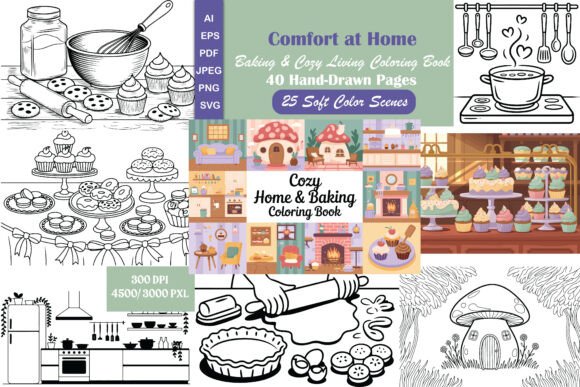
Home Baking Coloring Collection
A Designer’s First Glance: Warmth, Whimsy, and Stitch-Ready Simplicity
When I opened Home Baking Coloring Collection, my first thought wasn’t “cute” — it was “usable.” As someone who turns coloring-style graphics into machine embroidery designs for Etsy sellers, boutique aprons, and custom baby onesies, I scan for rhythm, breathing room, and line confidence. This collection delivers that quiet clarity: soft-edged cupcakes with gentle contour lines, open-kitchen vignettes built around clear negative space, and baking tools drawn with consistent stroke weight — not too thin to vanish in satin stitch, not so bold they’ll overwhelm a tea towel or cap brim. It feels like a hand-drawn sketchbook made for translation, not just coloring. That matters — because the more natural the line flow, the smoother the stitch path.
Where It Shines: Real Projects, Real Fabric, Real Customers
I tested Home Baking Coloring Collection as the core motif for a small-batch embroidered tote bag series aimed at local bakeries and kitchen boutiques. The result? A relaxed, approachable aesthetic that reads instantly — no decoding needed. On medium-weight canvas, the outlines held clean detail without excessive fill stitch density. On a lightweight cotton sweatshirt, I scaled down a single cupcake motif (no background clutter) and paired it with a subtle running-stitch border — it looked handmade, not mass-produced. For baby bibs and nursery pillow covers, the fireplace-and-mug scene translated beautifully into low-density fill stitch with gentle satin edges — soft to the touch, warm to the eye.
This isn’t a design that shouts. It invites. That makes it ideal for personalized gifts (think: monogram + tiny whisk motif on a linen kitchen towel), holiday embroidery (a gingerbread house outline stitched in red-and-cream thread on a wool blend blanket), or craft fair merchandise where customers respond to sincerity over flash. As an Etsy seller, I’d list it alongside mockups showing both light and dark fabric — because its charm lies in contrast, not coverage.
Where to Pause — Not Problems, Just Practical Checks
Home Baking Coloring Collection works best when you respect its gentle scale. Avoid cramming full-page scenes onto a 3-inch hoop — those cozy kitchen corners will lose legibility. On stretchy fabrics like jersey or ribbed knit, stabilize generously: the open-line style relies on clean registration, and any puckering blurs the intention. Tiny lettering (like “bake joy” tucked into a rolling pin) needs verification — if it’s under 6mm tall, test it on scrap first. And while the fireplaces and oven mitts read well in black thread on cream linen, they’ll need higher-contrast thread on charcoal terry cloth or dark denim — don’t assume default colors carry the mood.
Curved surfaces — like the front of a dad cap — call for simplification. Pick one element (a single cinnamon roll, not the whole breakfast spread) and verify stitch count stays moderate. Dense fill areas — say, a shaded oven interior — may require reduced density or strategic underlay to prevent stiffness on wearable items. Always check how fine details behave after washing: delicate swirls on a whisk handle should remain distinct, not blur into a blob.
Why It Builds Trust — In Your Brand and Your Buyer’s Hands
Customers don’t buy embroidery — they buy feeling. Home Baking Coloring Collection delivers comfort without cliché. It avoids over-sweetened tropes and leans into quiet authenticity: a chipped mug, slightly crooked cookie tray, soft shadow under a flour sack. That nuance signals care — to your client, your customer, your own standards. When used thoughtfully, it elevates a basic tote bag from “nice” to “thoughtful gift.” It supports brand consistency for small shops leaning into slow living, handmade food culture, or mindful gifting. And because it’s rooted in coloring-page logic — clear boundaries, intentional spacing, balanced composition — it scales predictably across product types: from 2-inch embroidered patches to 8-inch pillow cover centerpieces.
Designer Notes You’ll Actually Use
- Always test on scrap fabric first — especially with textured weaves (linen, toweling) where line weight can disappear.
- Review stitch density before sending to machine — low-fill versions often work better for apparel than heavy fills.
- Confirm hoop size compatibility — if your target product uses a 4x4 hoop, avoid motifs designed for 5x7 unless resized intentionally.
- Inspect small details at actual stitch size: does that sugar sprinkle hold shape? Does the spoon’s curve read clearly?
- Test black-and-white mockups — if it loses charm without color, rework thread selection or simplify.
- Compare light vs. dark fabric backgrounds — what reads softly on ivory may vanish on navy without adjusted thread tone or underlay.
- Use appropriate stabilizer — tear-away for stable wovens, cut-away for knits, and maybe topping for napped fabrics like terry.
- Verify licensing — since this is listed under Coloring Pages Amp and categorized as Graphics, confirm whether commercial use of finished embroidered products or digital embroidery files is permitted before listing on Etsy or in your shop.
Final Thought: A Design That Serves the Maker
Home Baking Coloring Collection doesn’t ask you to force it into trends. It asks you to listen — to your fabric, your stitcher’s instinct, your customer’s unspoken desire for calm. It’s the kind of design that makes embroidery feel like hospitality: generous with space, respectful of material, and quietly confident in its own warmth. Whether you’re stitching a holiday gift for a new parent, building a cohesive line of kitchen-themed merchandise, or creating your next best-selling digital embroidery file, this collection gives you room to breathe — and stitch — with intention.