Dinosaur Adventure Coloring Book for Kid
A Designer’s First Glance: Friendly, Fluid, and Full of Potential
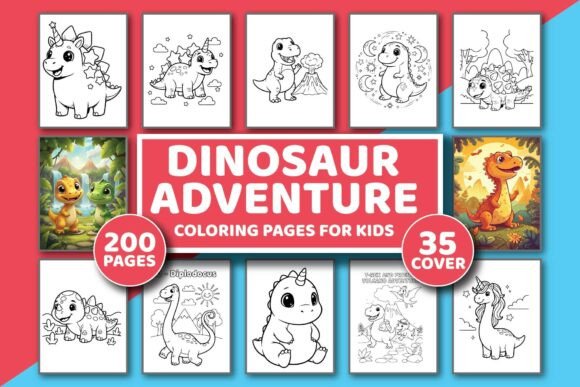
Opening Dinosaur Adventure Coloring Book for Kid, I immediately notice what sets it apart from most kids’ dinosaur graphics: no jagged edges, no aggressive postures, no overwrought detail. These are soft-contoured, wide-eyed, gently posed dinos—think smiling stegosauruses with rounded plates and triceratops with stubby, friendly horns. As an embroidery designer who’s stitched everything from nursery wall art to boutique baby onesies, that first impression matters deeply. It tells me this isn’t just a coloring page—it’s a design asset built for warmth, approachability, and real-world stitchability.
Why This Fits So Naturally in Embroidery Projects
I recently used one of the simpler full-page dino outlines—a cheerful brachiosaurus with a curved neck and open space inside its body—to create a custom embroidered tote bag for a local preschool teacher. The result? Clean satin-stitched outlines held beautifully on medium-weight canvas, and the interior fill area gave me room to add gentle fill-stitch grass or a subtle sky gradient without overcrowding. That flexibility is rare in kids’ graphics—and it’s why Dinosaur Adventure Coloring Book for Kid works so well as embroidery source material.
It shines brightest on projects where clarity and charm matter more than complexity: baby embroidery (onesies, burp cloths), sweatshirt embroidery (especially for toddlers), embroidered patches (great for scout badges or daycare uniforms), and kitchen towels or aprons for playful family brands. Because the lines are bold but not dense, and the shapes are generous—not cramped or fussy—it translates cleanly into running stitch outlines, satin borders, and light fill areas. No need to simplify or redraw; the foundation is already embroidery-ready.
Where to Use It Thoughtfully—Not Just Automatically
That said, not every page—or every use case—is equal. The 200-page bundle includes some tighter scenes: dino families in small clusters, footprint trails, or banner-style text like “ROAR!” that uses thin, delicate lettering. Those demand extra attention. On stretchy fabric like cotton jersey (think toddler t-shirts), those fine lines can blur or pucker unless stabilized properly. On dark fabric, low-contrast thread choices will disappear—so test your thread colors early, especially for satin-stitched eyes or tiny spikes. And avoid using the most detailed multi-dino pages on small hoop sizes (under 4”); they’ll lose legibility and increase stitch density unnecessarily.
I also recommend skipping the denser background elements—like jungle vines or star-filled skies—for anything meant for frequent washing (baby blankets, tea towels) or textured surfaces (knit caps, corduroy aprons). They’re lovely in print, but in stitch, they risk stiffness or snagging. Stick to single-subject frames or clean silhouette pages when building durable, wash-friendly finished products.
Real Impact on Your Craft Business
For Etsy sellers and small shop owners, Dinosaur Adventure Coloring Book for Kid adds instant visual trust. Parents scrolling for personalized gifts respond strongly to designs that feel safe, joyful, and age-appropriate—not cartoonish or chaotic. When you embroider one of these dinos onto a linen pillow cover or organic cotton bib, customers don’t just see a product—they recognize intention. That builds brand consistency across your handmade product line and lifts perceived value, even at mid-tier price points.
It also supports smart digital product strategy. As a Graphics category item under Coloring Pages Amp, it’s ideal for creating printable mockups—showcasing how your embroidered version would look *before* stitching. Pair a clean black-and-white scan of a dino outline with a realistic fabric texture overlay, and you’ve got compelling Etsy listing visuals. Just remember: if you’re reselling digital embroidery files derived from this bundle, confirm licensing terms first. Not all coloring assets permit commercial digitization or redistribution.
Practical Notes Every Embroidery Designer Should Check
- Test on scrap fabric first—especially with blends or knits. See how the line weight holds up after hooping and stitching.
- Review stitch density before scaling. Some pages may look airy at 100% but become overly dense at 150%—a common pitfall when adapting coloring book art to larger apparel.
- Confirm hoop size compatibility. Many pages are designed for standard coloring-book proportions—not embroidery hoops—so isolate and resize key elements thoughtfully.
- Inspect small details: eyes, claws, flower accents. If they’re under 2mm in the original, they’ll vanish in stitch unless converted to strategic satin dots or left out entirely.
- Try black-and-white mockups to assess contrast and hierarchy—this reveals whether a dino reads clearly against busy or dark backgrounds.
- Use proper stabilizer: medium tear-away for stable wovens, cut-away for knits, and lightweight fusible for delicate items like baby hats.
- Verify commercial use rights before selling finished embroidered items or digitized versions. Licensing isn’t always included with Coloring Pages Amp bundles.
The Bottom Line for Makers Who Stitch With Intention
Dinosaur Adventure Coloring Book for Kid isn’t flashy—but it’s quietly capable. It doesn’t shout. It invites. That makes it unusually versatile for embroidery designers balancing creativity with practicality: a reliable starting point for custom apparel, a thoughtful anchor for nursery decor, a charming accent for holiday embroidery, and a trustworthy asset for craft businesses building recognizable, heartfelt branding. Used with care—scaled right, stabilized well, and matched to the right fabric and end use—it delivers professional results without demanding perfection from your machine or your time.
Just remember: great embroidery starts with smart source material. And in a sea of loud, overdesigned kids’ graphics, this one earns its place—not because it’s complex, but because it’s kind, clear, and genuinely ready to be stitched.