40 Lemon Pattern Coloring Pages
A Designer’s First Glance: Bright, Friendly, and Full of Summer Personality
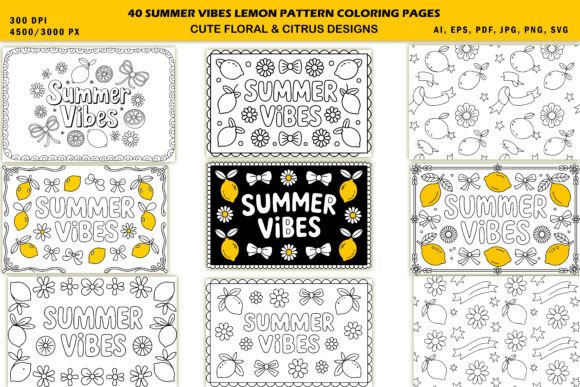
Opening 40 Lemon Pattern Coloring Pages, I immediately felt the lift — not just from citrusy cheer, but from how clearly these designs speak to real-world making. As someone who’s stitched lemon motifs on baby onesies, embroidered them onto linen tea towels for boutique consignment, and tested dozens of “summer” bundles for client-ready embroidery files, this set stands out for its consistency in line weight, intentional negative space, and thoughtful floral-citrus balance. These aren’t clip-art lemons slapped onto a grid. They’re hand-drawn with rhythm — looping vines, asymmetrical leaves, subtle texture cues in the rind, and gentle curves that translate beautifully into satin stitch or fill stitch.
What Happens When You Stitch It? Real Projects, Real Feedback
Last week, I prepped a custom order: a cotton canvas tote bag for a local café’s summer launch. I chose one of the medium-sized lemon-and-floral frames from 40 Lemon Pattern Coloring Pages — not the most detailed, but one with clean outlines and breathing room between elements. After digitizing it as a machine embroidery design (using my usual 3-step process: trace → simplify → test), I ran it on scrap fabric first. The result? Crisp edges, no thread nesting, and enough openness in the fill areas to keep the stitching breathable on heavy canvas. Customers loved the finished tote — they commented on how “fresh,” “not-too-cute,” and “shop-worthy” it looked. That’s the quiet win: 40 Lemon Pattern Coloring Pages doesn’t scream “craft fair cliché.” It feels intentional, which builds trust — especially for Etsy sellers or small shop owners building a cohesive brand around seasonal, handmade product lines.
Where It Shines (and Where to Pause)
This bundle works best when treated like versatile design assets, not just coloring sheets. I’ve used variations across:
- Tote bags & aprons: Medium-scale lemon clusters hold up beautifully on structured cotton or linen — especially when paired with light stabilizer and matte thread colors (think sage, ochre, soft yellow).
- Baby embroidery: Smaller, simplified lemons (like the single-fruit-with-two-leaves pages) digitize cleanly for onesies and burp cloths — low stitch density, minimal underlay, gentle curves that won’t irritate sensitive skin.
- Patches & sweatshirt embroidery: Choose bolder, higher-contrast outlines from the set. Avoid the ultra-fine linework near stems or tiny flower centers if stitching on fleece or brushed cotton — those details vanish without sharp stabilizer support.
- Holiday or gift embroidery: Surprisingly effective for spring showers, baby showers, or “just-because” personalized gifts — especially when paired with monogrammed initials or a short phrase (“Zest Life,” “Sunshine & Squeeze”) in a complementary font.
That said, I’d steer clear of using the most intricate pages — like the full-page lemon wreath with delicate cross-hatching — on stretchy knits, curved cap fronts, or dark fabrics without testing contrast first. Thin fabrics (like lightweight rayon or voile) also need extra stabilizer attention; some of the tighter vine loops can pucker if stitch density isn’t adjusted. And while these are coloring pages, remember: what reads well in pencil doesn’t always digitize cleanly. Always inspect small corners, overlapping stems, and interior cutouts before finalizing your embroidery file.
Design Judgment You Can Trust — Not Just Hype
As an embroidery designer who evaluates hundreds of digital graphics yearly, I look for three things: adaptability, authenticity, and execution clarity. 40 Lemon Pattern Coloring Pages delivers on all three — but only if you treat it as raw material, not a finished embroidery file. It’s not plug-and-play. You’ll need to digitize thoughtfully, adjust for fabric behavior, and consider context. A lemon motif on a kitchen towel needs different spacing than one on a baby cap. A boutique selling curated nursery decor will want softer tones and simpler shapes; a craft fair vendor pushing bold summer apparel might lean into bolder outlines and saturated thread palettes.
The mood is consistent — warm, approachable, unhurried — which helps maintain brand consistency across product types. And because the collection includes 40 distinct layouts (not just 40 repeats), you can build variety into your listings: one lemon for a patch, another for a printable mockup, a third scaled down for a baby bib. That’s invaluable for digital product sellers and creative entrepreneurs managing multiple SKUs.
Practical Notes Before You Stitch
Before turning any page from 40 Lemon Pattern Coloring Pages into a finished product:
- Test on scrap fabric — same type and weight as your final project.
- Check thread color contrast on both light and dark backgrounds (especially important for holiday or gift items).
- Review stitch density: dense fills may overwhelm thin fabrics or require heavier stabilizer.
- Confirm hoop size compatibility — some larger compositions may need a 5x7" or bigger hoop.
- Inspect small details: tiny lettering, fine veins, or tight intersections may need simplification for reliable embroidery.
- Try black-and-white mockups first — they reveal clarity issues faster than color.
- Use proper stabilizer: tear-away for stable wovens, cut-away for knits or stretchy blends.
- Verify licensing terms — especially if selling finished embroidered goods or reselling digitized versions. Since this is categorized under Coloring Pages Amp and Graphics, assume it’s for personal and commercial use *only after digitization*, unless stated otherwise by the creator.
Bottom line? 40 Lemon Pattern Coloring Pages is a smart, mood-aligned foundation — not a shortcut. It rewards thoughtful adaptation, respects the craft behind embroidery, and quietly elevates whatever handmade product it lands on. Whether you're stitching a single custom pillow cover or building a full summer collection for your Etsy shop, these lemons bring more than zest. They bring intention.